A wall of folder boxes.
This software did not start on a screen. It started as clear plastic boxes screwed to a wall in a cabinet showroom in Pompton Plains, New Jersey.
This software did not start on a screen. It started as clear plastic boxes screwed to a wall in a cabinet showroom in Pompton Plains, New Jersey.
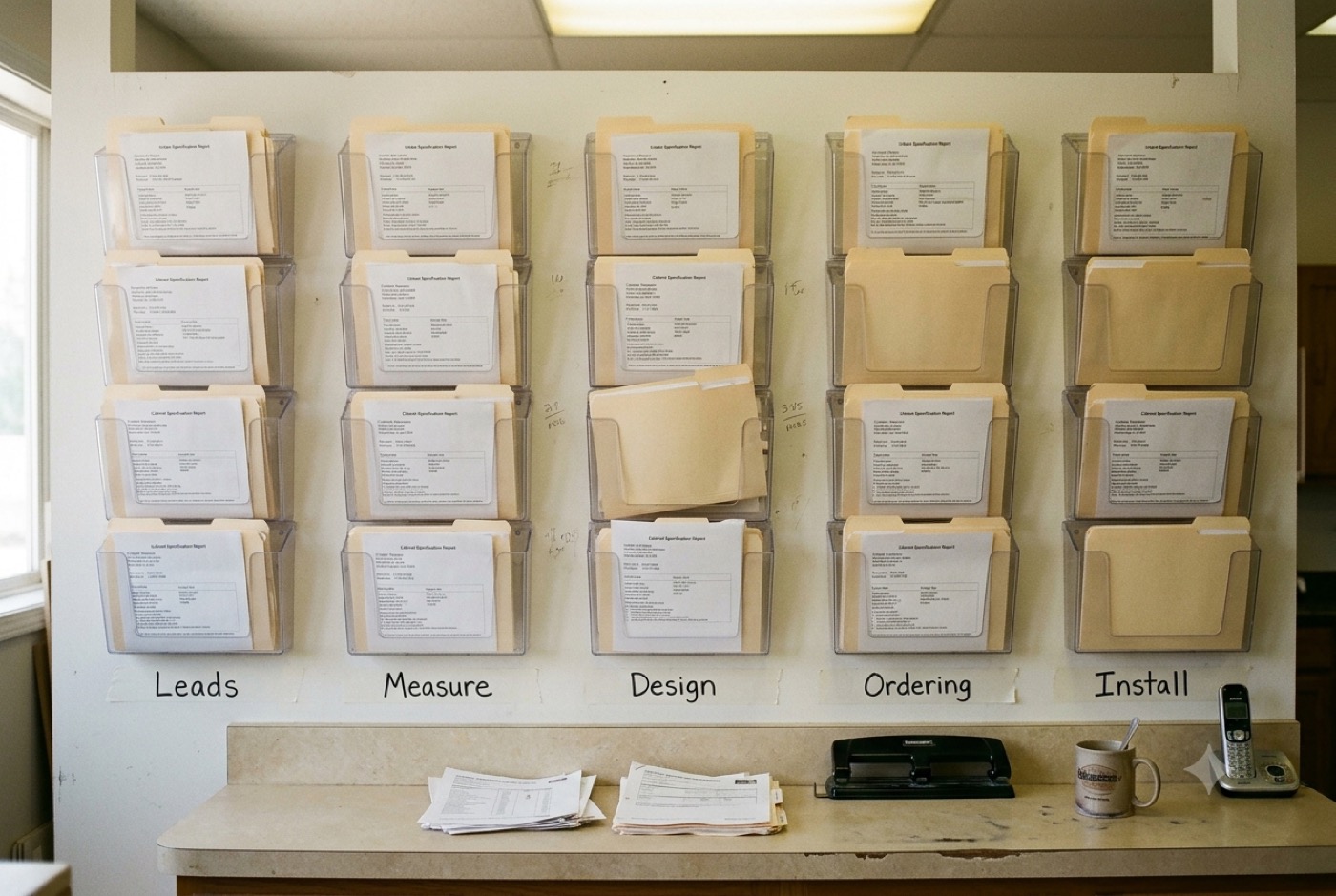
A customer walked in. The designer pulled a clear folder off the wall with a printed intake sheet already in it. The customer information faced outward so nobody had to open the folder to know whose job it was.
As the job moved, more sheets went in. Measure. Design. Quote. Deposit. Order. Acknowledgement. Delivery. Every stage had its own box, and the designer physically carried the folder from one box to the next.
Anyone could walk up to that wall and see the whole business in one look. Where every job was. What was stuck. Who was sitting on something.
We ran the business that way for months before anything got built. By the time code was written, the workflow had already been proven by hand, in front of real customers, with real deposits on the line. That wall is the order workflow in the software today. Same stages. Same order.
“I never designed this at a whiteboard. I designed it at a wall of folder boxes, because I was the one filing the folders.”
I came to this country at ten years old without speaking English. I started pre-med and dropped it in my junior year, which did not go over well at home. I took a masters in Management Information Systems instead.
From 2002 to 2014 I worked at a legal publishing company. I started as an editorial assistant and left as CIO. I took a print-only monthly newspaper online and built the editorial system they kept using for seven years after I was gone. That is the part of my resume that taught me software.
On the side, my brother and I were building and flipping houses. Then 2008 happened. We were left holding an 8,700 square foot house that nobody would buy.
Remodeling was the only thing still moving. So in 2010 we opened a cabinet showroom. It did $700,000 in the first seven months and $2.4 million by year three. I was CIO at my day job and running a cabinet business on nights and weekends.
In 2015 we opened a second location to grow. It made the business worse.
The constraint was never floor space. It was people. More square footage did not give us another designer who could hold a job together from measure to install. We closed it. That mistake cost real money and it is the reason I do not believe growth problems are usually space problems.
We tried what was on the market. None of it was built by anyone who had sold a kitchen. It assumed a kitchen is a list of parts. A kitchen is a list of parts that changes four times before anyone signs anything.
So I built our own quoting, CRM and order system. Not to start a software company. To stop losing jobs in the gap between the design file and the price list.
Around 2019 we launched CabinetDeals and started selling full custom kitchens online, nationally. The industry said that could not be done. It runs on the same software. In 2023 we spun the software out as KBB Suite.
“The bottleneck was never the design. It was the retyping.”
The first time I took KBB Suite to market, I sold it as a complete system. The pitch was that the owner would not have to touch every order anymore. Nobody bought it.
It took me a while to understand why. In a showroom this size, the owner is the bottleneck on purpose. Every quote crosses their desk because one bad job eats a month of profit. That habit is not laziness or ego. It is quality control that has been earned the hard way.
I thought I was selling efficiency. I was actually asking them to give up the one thing that makes them feel safe.
So I stopped selling the system. Now I lead with the one piece that takes something off your desk without taking anything away from you. The quoting tool does the typing. You still read every quote before it goes out. Nothing about how you run your shop has to change.
If any of this sounds like your week, the quoting tool is the place to start. It takes one email address and one design you have already quoted by hand.
Try the quoting tool